find connections between two individuals with the same surname
indicate roughly when two individuals shared a common ancestor
prove whether families with the same surname are related
eliminate individuals or families with the same surname as being related
identify and find proof of change of surname, variation in surname and use of alias
compliment one-name studies - prove that everyone bearing the same surname are related
reveal uncertain paternity through illegitimacy or adoption
prove whether family stories and origin histories are true
test and corroborate conventional documentary research linking individuals and families
enable colonials and the descendants of diasporas to identify their geographical origins
track deep ancestral migration
The test analyses this single chromosome at pre-agreed markers — known as short-tandem repeats (STRs) — each of which has a tendency to mutate at a slightly different rate. The standard test today covers 37-43 markers with the option to increase that to 67 markers and beyond. A Y-DNA result on its own is of little use to a genealogist. Its value comes when comparing a result with other people's and specifically with men who share the same surname or variant.
It is not unusual for men who share their same-surname ancestor back 6-10 generations to have identical Y-DNA results at 37 markers, though the further back in time the shared ancestor lived the more likely that one or other of the tested lines of descendants will have acquired at least one mutational difference at some point since.
Note that the DNA result will not supply the name of the common ancestor and can only indicate when that ancestor lived within a span of a number of generations — this detail can only be determined by traditional documentary research.
HOW TO USE THIS INFORMATION
 Once
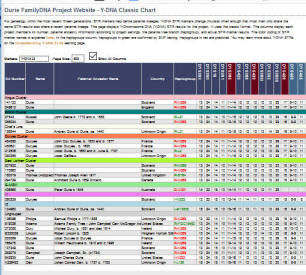
you join the Durie DNA Project, visit hereto see the full Y-DNA results https://www.familytreedna.com/groups/durie/dna-results
Once
you join the Durie DNA Project, visit hereto see the full Y-DNA results https://www.familytreedna.com/groups/durie/dna-results
Specifically (for a full Y-DNA Classic Chart) https://www.familytreedna.com/public/Durie?iframe=yresults
Why are some Duries such a poor match?
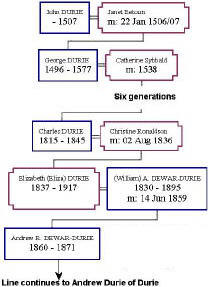
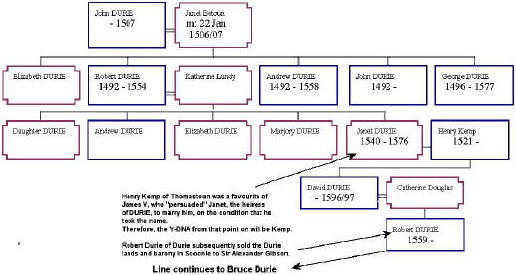
Although both Andrew Durie and Bruce Durie descend from the original Durie line, there has been a break in the Y-chromosome inheritance in both lines, due to both
producing a female heiress.
What are the R1b and I1a2b1 Haplotypes?
There are two branches of the family, Durie of Craigluscar the present chief, and secondly Durie of Durie who lost the Barony, Rossend Castle and the lands at Scoonie in the sixteenth century.
Durie of Craigluscar is represented by kit 158844 in the Durie DNA Project. His haplogroup
is R-FGC65724
This is four steps "downstream" of R-DF23 (= R1b1a1b1a1a2c1a1a1a1).
DF23 emerged between 270 CE and 800 CE (average 560 CE), possibly in the
south-west of England
The descent from DF23 went:
R-DF23 (ca. 2130 BCE) >> R-Z2961 (ca. 2040 BCE) >> R-ZP75 (ca. 1750
BCE) >> R-ZP77 (ca. 1680 BCE) >> R-FGC6550 (ca. 560 CE)
It is ultimatey within the clade R-M269 (R1b1a1a2)
Durie of that Ilk is represented by Dr Bruce Durie (kit 134963) and his haplogroup
is I-BY3808 - 3 steps downstream from I-Y4751 = I2a1b1a1a1a1a1, part of the
larger clade I2b1a-M284. Previously called I1b2a1, I2b1a-M284-Isles/Sc is 100% Pre-Roman and typical of "Pictish" or indigenous Scotland. This haplogroup is found almost exclusively among the population of the British Isles indicating the clade may have a very long presence in that locality.
The nearest match is with a Philp possibly from Fife. As both the Durie and Philp men tested with Family Tree DNA it is possible to calculate the Time to the Most Recent Common Ancestor (TMRCA) using the TiP™ calculator available via the matches on each individuals homepage. The calculations take into account the specific mutation rates of the first 37 markers. It is also unique in incorporating marker-specific differences, generating considerably improved power relative to any other analysis. With a 35/37 match, Tip calculated that the TMRCA was 96.29% probability within 16 generations and an 98.93% probability within the last 20 generations.
There is more information on the I-M223 Y-Haplogroup and its downstream sub-clades at https://www.familytreedna.com/groups/m223-y-clan/about
How can I join the Durie DNA Project?
First, take a Y-DNA test (37 or 67 markers) at
www.ftdna.com
Test kits can be purchased at the discounted project prices and paid for in £Sterling, contact Alasdair at
scottishdna@strath.ac.uk
It is recommended to take the 37-marker test or the 67-marker test first, then upgrade if required to a specific SNP Pack or Big Y
You may have done so already, in which case, join the Durie Surname Project. There is more information at:

 By
DNA testing, we can track the Durie family via the Y-chromosome. So far there are Short Tandem Repeat (STR) analyses and some Single Nucleotide Polymorphism (SNP) markers for family members from tests performed by FamilyTreeDNA (
By
DNA testing, we can track the Durie family via the Y-chromosome. So far there are Short Tandem Repeat (STR) analyses and some Single Nucleotide Polymorphism (SNP) markers for family members from tests performed by FamilyTreeDNA (